
 Facebook
 X
X
 Pinterest
 Copy Link
VA home loans · New Hampshire · Updated 2026
What changed for sheds, paint and property condition?
A practical guide to the May 2026 VA appraisal update for older homes, detached garages, barns and rural New Hampshire properties.
The distinction that matters
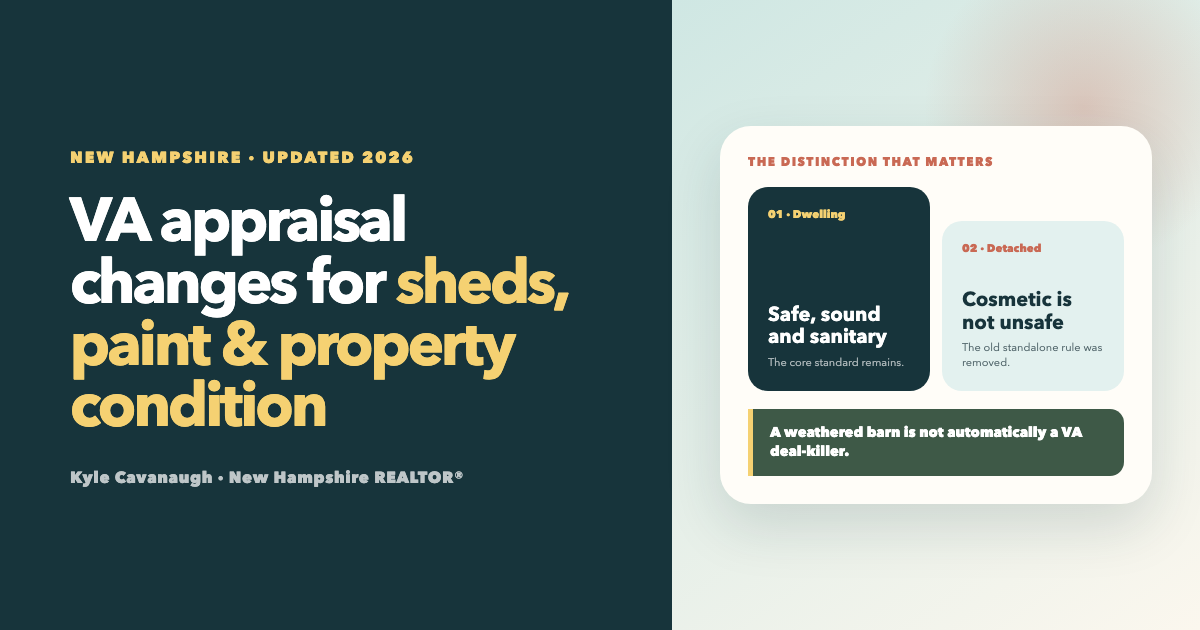
The VA did not stop caring about condition. It stopped treating every detached shed or barn like the home itself.
A weathered shed should not be confused with an unsafe home. That matters in New Hampshire, where a great property may come with an older barn, detached garage, workshop or outbuilding that simply looks its age.
The plain-English answer
What actually changed?
The update is helpful, but narrower than some headlines make it sound.
The standalone rule was removed
The former automatic treatment for detached sheds and other site improvements is no longer its own VA Minimum Property Requirement.
Normal wear is not a repair list
Cosmetic items, normal wear, minor deferred maintenance and inconsequential items generally should not become repair conditions by themselves.
Defective paint is normally cosmetic
The current handbook says defective paint on a dwelling built in 1978 or later is normally considered cosmetic.
The dwelling’s lead-paint rule remains
Lead-based paint is still presumed on a pre-1978 dwelling, and defective lead-based paint remains a safety hazard that must be remediated.
Sheds, barns and detached garages
Imperfect does not automatically mean ineligible.
A detached building can look rough without making the home unsafe. Its condition still needs to be understood in context.
More likely to be cosmetic
These items may affect condition or value without automatically becoming required repairs.
- Faded or weathered finishes
- Worn but serviceable surfaces
- An older, stable shed that is not attractive
- Minor deferred maintenance without a safety concern
- Defective paint on a 1978-or-later dwelling
What can still matter
The update is not a blanket exemption for every detached structure.
- An actual collapse or safety hazard
- Encroachment on a boundary, easement or right-of-way
- Unpermitted work or a local enforcement order
- Visible rot, insect damage, exposed wiring or active leakage
- A problem affecting use, insurability, marketability or value
Peeling paint
The year of the dwelling changes the answer.
This is one of the most important details to understand before assuming a repair will or will not be required.
Normally cosmetic
The current VA guidance says defective paint on the dwelling is normally considered cosmetic. A separate underlying problem, such as decay or water intrusion, can still matter.
Lead paint is presumed
Defective lead-based paint on the dwelling remains a safety hazard that generally must be remediated. Federal lead disclosure requirements also remain in place for most pre-1978 housing.
Why outbuildings are part of the story: The 2026 update removed the words “or related improvements” from the pre-1978 provision. A peeling old shed or barn is therefore no longer automatically treated like the main dwelling solely because it sits on the property. The appraiser and lender still evaluate the actual facts.
The New Hampshire layer
The VA update did not erase local due diligence.
Rural and older properties can involve several systems, records and rules. These questions remain important even when an outbuilding is only cosmetic.
Still worth testing
The VA removed its standalone radon MPR topic. New Hampshire still requires a written radon notification, and testing is the only way to establish whether radon is present.
Separate requirements remain
VA water-quality and sanitary-disposal rules still apply. New Hampshire has its own disclosures, and certain developed waterfront transfers require a licensed septic evaluation.
Visible evidence can trigger review
New Hampshire is not on VA’s routine statewide pest-inspection list. Apparent infestation, fungus, dry rot or damage can still trigger an inspection and repairs.
The structure still needs a legal story
The change does not legalize an unpermitted garage, barn conversion or accessory dwelling unit. Zoning, permits, septic capacity, access and intended use should be researched early.
The appraisal protects the loan process. Your inspections help you understand what you are actually buying.
Appraisal versus inspection
They are not the same job.
A VA appraisal supports an opinion of value and identifies readily apparent conditions related to the Minimum Property Requirements. The appraiser does not conduct a full home inspection or operationally test every system and appliance.
I still recommend considering a qualified, independent home inspection and the property-specific reviews that make sense. On a rural New Hampshire property, that may include well-water testing, septic evaluation, radon testing, chimney work, pest review or a specialist’s opinion on an outbuilding.
If a problem is identified
“Subject to repair” is a next step, not an automatic dead end.
The parties first need to understand the exact condition, the signed agreement and the lender’s direction.
Identify the condition
Separate a true VA repair requirement from an inspection recommendation, cosmetic item or lender-specific overlay.
Gather the right facts
Use the appraiser, lender, inspector, specialist or municipality that actually has authority over the question.
Review the options
Depending on the contract and property, the parties may negotiate, complete work, adjust the transaction or decide the home is not the right fit.
Before making an offer
Eight questions I would want answered early.
The goal is not to find reasons to fear the property. It is to identify the right questions before time, money and emotion are tied up in the transaction.
-
What year was the main dwelling built?The answer changes how deteriorated paint is treated.
-
Is pre-1978 paint visibly deteriorated?Peeling, chipping or flaking paint deserves early attention.
-
Are safety or structural concerns visible?Look beyond finishes to moisture, movement, wiring, decay and access.
-
Which outbuildings matter to the purchase?Be clear about intended use and whether they contribute value.
-
Do records support the structures?Review tax cards, surveys, permits, septic plans and municipal files where relevant.
-
Are there rural systems or access issues?Private wells, septic systems, private roads and waterfront rules need their own review.
-
Has the lender seen the unusual feature?Ask property-specific questions before appraisal whenever possible.
-
Which independent inspections make sense?Keep appraisal and buyer due diligence as separate decisions.
Buyer questions
A few direct answers.
Does a shed have to be perfect for a VA appraisal?
No. Ordinary cosmetic wear on a detached shed should not be confused with a defect in the dwelling. The old standalone detached-improvement rule was removed for appraisals ordered after May 1, 2026. A real hazard, encroachment, code issue or value concern can still matter.
Will peeling paint stop a VA loan?
It depends on where the paint is and when the dwelling was built. Defective paint on a 1978-or-later dwelling is normally cosmetic under current guidance. Defective paint on a pre-1978 dwelling remains a presumed lead-based-paint concern and generally must be corrected.
Can I buy an old New Hampshire farmhouse with a VA loan?
Potentially, yes. Older does not automatically mean unacceptable. The property must support the appraised value and meet applicable requirements. Older homes simply make it more important to understand paint, systems, structure, water, septic and the intended use of farm improvements.
Can a VA loan buy a homestead or working farm?
A Veteran may use a VA loan for an owner-occupied farm residence. VA does not finance the farm business itself, and livestock, crops, equipment and supplies are not included in value. Barns, sheds and similar improvements are considered only for the value they contribute to the property’s residential use. A residential homestead with acreage is not automatically the same as financing a commercial farm, so property-specific lender and appraisal review matters.
Does the VA appraisal replace a home inspection?
No. The VA specifically distinguishes the appraisal from a home inspection. It does not provide the same depth of system testing, condition review or buyer education as an independent inspection.
Who decides whether a repair is required?
The VA-assigned appraiser identifies applicable property conditions, and the lender reviews the appraisal under VA requirements and any lender-specific rules. A real estate agent can coordinate and advocate, but cannot promise that a property will pass.
Looking at a rural NH property?
Send me the listing before you get too far.
I will help you identify the right questions about the home, outbuildings and land, then coordinate with the lender, appraiser, inspector and municipality where appropriate. You do not need a property to be cosmetically perfect. You do need a clear picture of what you are buying.


